
Competitive research usually becomes difficult for a boring reason: the team has plenty of pages but no shared answer to the decision that matters. An AI summary can make that problem look solved. It is not solved until the team can trace a claim, see what is still unknown, and decide what belongs in the first release.
This is a simple way to use AI without handing it the product decision. Let it collect and organize evidence. Keep scope, trade-offs, and approval with the people who own the product.
In this guide
- Frame one decision
- Assign small, checkable research jobs
- Turn a comparison into a PRD choice
- Mark certainty clearly
- Finish with a review checklist
Start with the decision, not the research
Write the decision in one sentence before opening a research tool. For example: “Should the first release include automated follow-up, and which customers can use it safely?” That is more useful than “research our competitors” because it gives the research a finish line.
Add four boundaries next: the target user, the products being compared, the date each source was checked, and what is out of scope. Atlassian describes a PRD as a shared reference for a product’s purpose, users, features, and success criteria. Those boundaries keep the document useful as a shared reference instead of a polished collection of facts.
Give the agent a bounded job
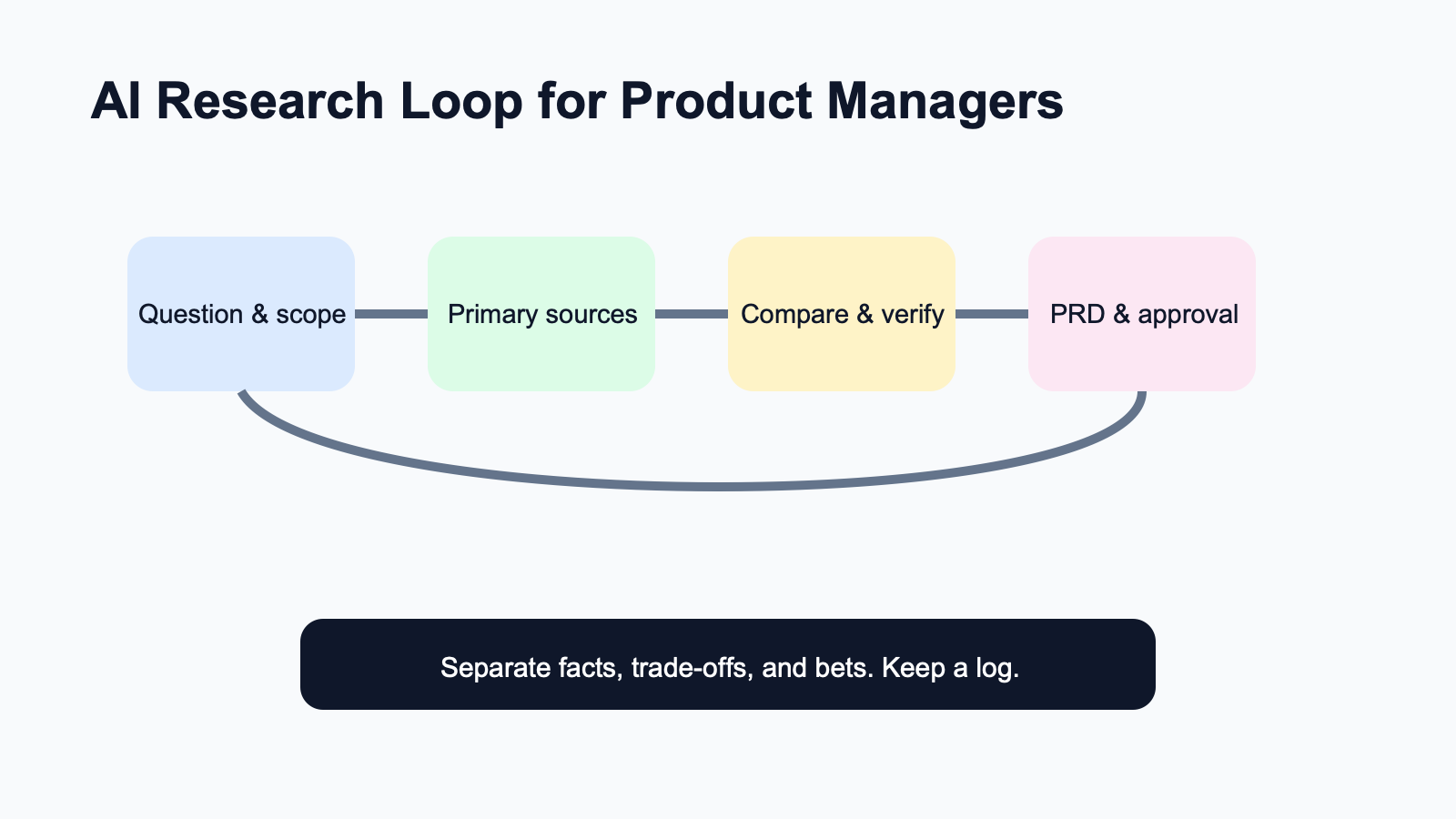
Do not ask one prompt to research a market, decide what matters, and write the PRD. Split the work. First, collect public primary pages. Next, extract the same fields from every page. Then flag missing information. Only after those steps should the tool produce a comparison draft.
For every material claim, keep the source URL and the date it was checked. If a page does not support the claim, write “unknown.” That is more useful than a confident guess when plan eligibility, product limits, or onboarding conditions could change the scope of a release. OpenAI’s guide to building agents makes the same practical distinction: tools and instructions can support a task, while guardrails constrain what the system is allowed to do.
Example: a feature decision that does not collapse
Imagine a team considering an automation feature for a collaboration product. An early comparison says that three competitors offer the feature. That sounds helpful, but it leaves out the details that determine scope: is it limited to a certain plan, does a user have to opt in, and does it only work in one part of the product?
A stronger research note records those conditions beside each claim. The PM can then make a reviewable choice: include onboarding in the first release, leave plan-based automation out for now, and validate one remaining gap with customer research. The source does not make the decision. It gives the team something specific to debate.
Separate facts, trade-offs, and bets
Every research document contains three different kinds of statements. A fact is supported by a source. A trade-off is the team’s interpretation of that fact. A bet is a hypothesis the team still needs to test. Mixing them is where an AI-written research note becomes misleading, because an inference can sound as settled as a documented fact.
- Fact: link to the source and state when it was checked.
- Trade-off: name the benefit and the cost the team is accepting.
- Bet: name the next test and the signal that would change the decision.
This small distinction makes PRD reviews faster. A designer, engineer, or researcher can challenge the right part of the document without reopening the entire conversation.
Keep approval with the team
Let the agent search public pages, normalize notes, and prepare a first draft. Keep prioritization, pricing language, legal implications, and external sharing with a person. These are product choices, not clerical steps.
The permission model should match that boundary. A research assistant can read public pages. A drafting assistant can prepare a document. Neither needs the authority to change a roadmap or send a customer message. Start with that narrow workflow and expand only when the team can explain how it fails and who corrects it.
Use this checklist before the PRD review
- Can the team state the decision in one sentence?
- Do the research notes show comparison criteria and source-check dates?
- Does every important claim have a source, or clearly say that it is unknown?
- Are facts, trade-offs, and bets visibly different?
- Does the PRD name who approves scope and external sharing?
- Can the reader take one concrete next step after finishing the page?
My editorial recommendation is to optimize for inspectable evidence, not the most polished first draft. A shorter comparison that exposes its uncertainty is more useful in a real planning meeting than a long summary that cannot answer where its claims came from.
Sources: Atlassian on product requirements documents; OpenAI’s practical guide to building agents; Google Cloud’s AI adoption framework.